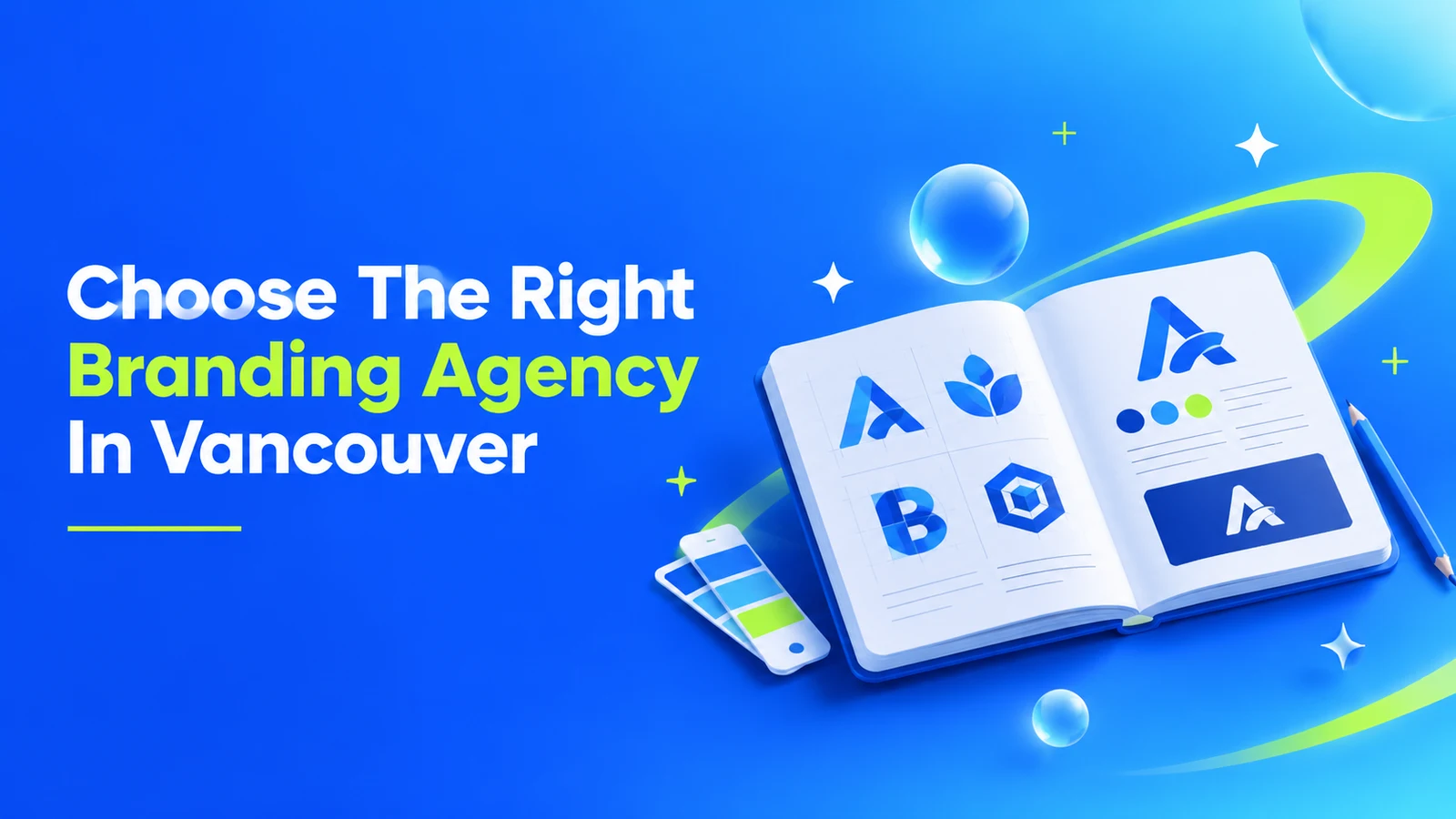
Most small businesses choose a branding agency the way they choose a restaurant: prettiest portfolio wins. Here is the buying checklist our team uses instead, with real Vancouver pricing ranges and the five questions that separate real partners from logo vendors.
Branding agencies in Vancouver: how to choose the right one
Here is the uncomfortable truth about how most small businesses hire a branding agency: they look at ten portfolios, pick the prettiest one, and sign. The portfolio is a museum. What you are buying is a future relationship, and the prettiest portfolio in the city tells you almost nothing about whether that relationship will work.
Our team has sat on both sides of this table. We deliver branding work ourselves, and we have watched businesses in Vancouver burn five figures on engagements that produced a nice logo and nothing that changed how the business sells. The difference between the two outcomes was never taste. It was the buying process.
This is the checklist we would hand you if you were sitting across from us, including the questions worth asking, what branding actually costs in 2026, what deliverables you should demand in writing, and the red flags that should end a conversation immediately.
What does a branding agency actually do?
A lot of confusion starts here, because "branding" gets used to mean everything from a logo to a full rebrand. A real branding agency sells three things, in this order:
1. Brand strategy. Positioning, audience definition, competitive differentiation, messaging, tone of voice. This is the thinking that decides what your brand should mean before anyone draws anything.
2. Visual identity. The logo suite, color system, typography, photography and illustration direction, iconography. These are the visible artifacts of the strategy, not the strategy itself.
3. Brand guidelines and handoff. The documented system that lets your team, your printer, your social media manager, and your future web designer apply the brand consistently without asking the agency for permission every time.
That third item is the one that separates an agency engagement from a freelance logo project. And it matters more than most buyers realize: across two separate Lucidpress (now Marq) studies surveying more than 600 brand management experts, consistent brand presentation across touchpoints was associated with revenue increases of 23% (2016 study) to 33% (2019 study). Yet only about a quarter of companies with brand guidelines actually enforce them. The guidelines document is where the consistency lives or dies.
If an agency's pitch skips straight from "hello" to logo concepts without a discovery phase covering strategy, you are not buying branding. You are buying decoration. Price it like decoration.
The five questions that reveal everything
Credit where it is due: the agency Confetti published a sharp framework for evaluating branding proposals, and it lines up almost exactly with what we have learned from real engagements. Ask every finalist these five questions before you compare a single price:
1. What does discovery specifically include? Ask what research, workshops, interviews, competitor analysis, or category work are included, and how much time is allocated. "Discovery" as a line item means nothing. Discovery as a described process, with named activities and hours, means the agency knows what it is selling you.
2. Who will actually develop the work? Find out who is hands-on during strategy and concept development. A senior creative director listed on the proposal means little if they only appear for the final presentation. This is one of the most common bait-and-switch patterns in agency work: the pitch team and the delivery team are different people.
3. How are revisions and decisions structured? Ask how many concept and refinement rounds are included, who makes approval decisions on your side, and what happens if the initial direction does not work. Rebrands die in approval limbo more often than they die from bad design. A serious agency has a written opinion about how decisions should be made.
4. Has the work been planned around real production constraints? For packaging, that means pack formats, print processes, and materials. For digital-first brands, it means favicons, social avatars, app icons, and how the identity behaves at tiny sizes. Ask the agency to explain how the proposed identity will survive contact with the real world.
5. How will the system extend beyond launch? If you expect more products, locations, or channels, ask the agency to explain how the proposed identity will accommodate growth without requiring a redesign each time. A brand that cannot stretch is a brand you will pay for twice.
Then audit each proposal line by line against your original brief, marking every item as included, excluded, unclear, or additional. Pay particular attention to strategy outputs (what decisions will the research actually produce?), revision rounds, implementation support, and exclusions (what could become an extra fee later?).
How to read a portfolio like a buyer, not a fan
Portfolios are curated highlight reels, but you can still extract real information from them if you stop looking at the pictures and start reading the cases:
- Do the case studies explain the why? Visual polish is table stakes. Look for write-ups that describe the business problem, the strategic decision, and the reasoning behind design choices. If every case study is three hero shots and a client name, the agency is selling taste, not thinking.
- Do they name real clients with real outcomes? Vague praise is cheap. Named clients and specific outcomes, even modest ones, are hard to fake. Video testimonials are harder to fake than written quotes.
- Can you see strategic thinking, not just style? The best agencies adapt their visual language to each client's problem. If every project in the portfolio looks like it came from the same template, you are looking at a house style, not a strategy practice.
- Do they have experience adjacent to your industry? Exact industry matches are a bonus, not a requirement. What matters is evidence they can learn a complex domain quickly: case studies that show them entering an unfamiliar category and getting the positioning right.
One more test, from the agency Toast's guide to commissioning branding work: notice what the agency asks YOU in the first conversation. A quality agency should be asking about your turnover, what a new customer is worth to you, who your customers are, where you find them, where the business is going, and whether you offer something genuinely different or a me-too product. These are the questions of a partner working out whether you are a good fit for them. If you never get asked these questions and the conversation jumps straight to mood boards, walk away. The agency is not qualifying you, which means it has not thought about whether it can deliver for you.
What branding costs in 2026 (honest ranges)
Nobody likes giving numbers, but you cannot budget without them. The pricing guides published this year are broadly consistent with each other, and they line up with what we see in the Vancouver market:
| Engagement level | Typical range | What it usually includes |
|---|---|---|
| Freelancer / DIY assist | $500 – $3,000 | Logo, color palette, basic font pairings; no strategy |
| Boutique agency | $5,000 – $15,000 | Full brand strategy, visual identity system, brand guidelines |
| Startup-specialist agency | $15,000 – $40,000 | Deep positioning, complete design systems, multi-channel rollout |
| Premium / full rebrand | $20,000 – $100,000+ | Deep research, full brand system, implementation support |
(Compiled from Glow's 2026 branding pricing guide, Byte Technology's 2026 small-business guide, and WeAreTenet's 2026 pricing breakdown. Ranges are USD and vary by market; Vancouver sits in the mid-to-upper part of each band.)
A few things these tables do not tell you:
Match the scope to your stage. A pre-revenue startup spending $40,000 on brand strategy is buying insurance against a risk it does not yet have. A funded company competing in a crowded category spending $3,000 on a logo is saving money it will spend again in eighteen months when the brand cannot stretch. The agency should be the one telling you this, even when it means a smaller engagement for them.
The cheapest quote is often the most expensive engagement. Exclusions turn into change orders. A $4,000 quote with no defined revision structure, no implementation support, and no guidelines document will cost you more in friction, rework, and a future rebrand than a $12,000 quote that includes all three.
Ask what a new customer is worth to you, then do the math. If a customer is worth $2,000 in lifetime value and better brand presentation lifts conversion by even a few percentage points, the boutique agency range pays for itself quickly. Branding is not an expense line. It is a conversion multiplier, and you should evaluate it like one.
Deliverables to demand in writing
Before you sign anything, make sure the scope of work names these items explicitly. "Brand identity" without a deliverables list is a blank check.
Strategy outputs: brand positioning statement, audience definition, competitive analysis summary, messaging hierarchy, tone of voice guidelines. If these are not listed, the agency is designing on instinct.
Visual identity: primary logo, logo variations (stacked, horizontal, icon-only, one-color, reversed), color system with exact values, typography system with licensed fonts, imagery direction.
Guidelines document: usage rules, clear-space and minimum sizes, do-nots, application examples. This is the asset that protects the other 25 to 33% of potential revenue that consistent presentation is associated with.
Source and export files: vector source files (AI, EPS, SVG) plus high-resolution raster exports (PNG, JPG), with full commercial ownership rights transferred to you. No exceptions. A brand you cannot open in the original format is a brand you rent, not own.
Applications you will actually use: social media templates, business cards or stationery, email signature, favicon and social avatars, and a rollout plan for your website that carries the new brand. A brand that ships without its most-used touchpoints is a strategy deck, not a working system.
Implementation support: who handles artwork, file handoff, production support, or rollout, and for how long after delivery. Brands break at handoff more often than at concept.
Red flags: end the conversation here
Some patterns are so reliably predictive of a bad engagement that they deserve a hard rule:
-
They show you logo options in the first meeting. Strategy has not happened yet. Whatever they are showing you is decoration, and they are hoping you fall in love before you ask hard questions.
-
No discovery phase exists in the proposal. Research, interviews, competitor analysis, audience work: if none of it is in the scope, none of it is happening, and the design will be based on the agency's taste instead of your market.
-
The senior team vanishes after the pitch. Ask directly who does the hands-on work. If the people who sold you the vision are not the people building it, you bought a presentation.
-
They cannot explain their process. Structured workflows, communication cadences, milestone frameworks: these are not bureaucracy. They are the difference between a project that ships and a project that drifts.
-
Everything in their portfolio looks the same. You are buying their house style, not a strategy practice built around your business.
-
The quote has no exclusions section. An agency that will not tell you what costs extra is planning to tell you later, when switching agencies is more expensive than paying.
-
They are the cheapest by a wide margin. Crowdsourced logo contests and $100 logo sites have a real failure mode: stock icons resold to multiple businesses, no source files, no strategy, no one to call when it breaks. Fine for a hobby. Dangerous for a business you are betting on.
The Vancouver-specific angle
Vancouver is a genuinely interesting branding market. The search data backs it up: "branding agencies vancouver" draws around 880 searches a month in Canada with low competitive difficulty, one of the easiest validated terms in the local agency space. That means two things for you as a buyer. First, there is real local supply, from freelancers through boutique studios to full-service agencies, so you can match scope to stage without settling. Second, it means agencies here compete hard for your attention, which is exactly why the evaluation checklist matters: when everyone is marketing to you, the portfolio stops being a filter and the process questions become one.
Practical notes for buying locally: meet the actual team in person before you sign, at least once. Ask which of their case studies involved businesses at your stage and revenue band, not just your industry. And check how they handle the handoff to your web team, because in Vancouver's market the brand almost always lands on a website next, and a brand that was designed without the website in mind will fight it at every breakpoint.
Our branding work, stated plainly
We will not pretend to be a neutral observer here. Our team does branding work for businesses that need the full chain: strategy, identity, guidelines, and the rollout onto web and marketing. A recent example: the full branding, social media, and digital marketing engagement for Esthera Interiors, where the brand system had to carry across interiors photography, social content, and the website without losing its character.
We mention this for one reason. The checklist above is the same one we would want a prospect to use on us. If an agency, including ours, cannot answer the five questions cleanly, show you strategy behind its portfolio, and quote in transparent ranges, do not hire it. The checklist does not care whose name is on the proposal.
Frequently asked questions
How much should a small business budget for branding in Vancouver? For a complete identity with strategy and guidelines, established small businesses in Vancouver typically land in the $5,000 to $15,000 range (boutique agency), based on 2026 pricing data. Logo-only projects run $500 to $3,000 with a freelancer. Anything under $500 usually means a stock or AI-generated mark with no strategy, no source files, and no one accountable for it.
What is the difference between a logo and a brand? A logo is one artifact: the mark. A brand is the full system: positioning, messaging, visual identity, guidelines, and how all of it shows up consistently at every touchpoint. We wrote a longer piece on this distinction: your logo is not your brand.
How long does a branding project take? Freelancer logo projects run one to three weeks. Boutique agency engagements with real strategy run four to eight weeks. Full rebrands with research and multi-channel rollout run eight to sixteen weeks. Anyone promising a complete brand with strategy in a week is skipping the strategy.
Should I hire a Vancouver agency or work remotely? Local has one real advantage: you can meet the team, see how they think in person, and hold them to the process they pitched. Remote widens your options and can lower cost. The checklist matters more than the geography. A bad local agency is worse than a good remote one.
Do I own the files when the project is done? You must, and it must be in the contract. Insist on vector source files (AI, EPS, SVG), high-resolution exports (PNG, JPG), and a written transfer of full commercial ownership rights. Never accept a project that ends with only flattened exports.
What should I prepare before contacting agencies? A one-page brief: what you sell, who buys it, what a customer is worth, your competitors, your budget range, and your timeline. Agencies that ask you these questions in the first call are the ones worth talking to. The ones that do not ask are telling you how the engagement will go.
Sources and further reading
Every figure and framework in this article comes from a named source, not from our memory:
- Confetti, "What makes a branding agency worth the premium price" (evaluation framework)
- Everything Design, "How to choose a branding and website agency (2026)" (buyer checklist)
- The Starr Conspiracy, "How to choose a B2B branding agency that moves pipeline" (four-criteria framework)
- Toast, "How to commission a branding agency" (fit questions)
- Glow, "How much does branding cost? Complete pricing guide (2026)"
- Byte Technology, "Branding services for small business: ultimate 2026 guide" (pricing models)
- Omnibound, "Brand consistency statistics (2026)" (Lucidpress, Edelman data compiled)
- Inc., "If you want to make 23% more money, then get consistent" (Lucidpress/Demand Metric study)
The short version
Choosing a branding agency is a buying decision, not a beauty contest. Demand a described discovery process. Find out who actually does the work. Require revision and decision structures in writing. Audit proposals line by line. Insist on strategy outputs, guidelines, source files, and ownership transfer. And watch what the agency asks you in the first meeting: the questions they ask are a preview of the partner they will be.
If you want a second opinion on a proposal you are evaluating, or you want to see how our team would scope your brand, the honest next step is a conversation. Book a free 15-minute branding scope call and bring the checklist. We will answer every question on it, about our work or anyone else's.